Three streams, one mission
The alliance's workstreams are live and open. Any FINOS member can participate in the working groups — no OSERA membership required.
Remediation Standards
One open standard so a fix from any producer is portable, verifiable and lock-in-free: it defines when a patched release is accepted into the OSERA repository — evidencing, signing, attestations, testing and conformance automation — aligned with Akrites, OpenSSF and the SCA ecosystem. Chaired by Dov Katz (Morgan Stanley).
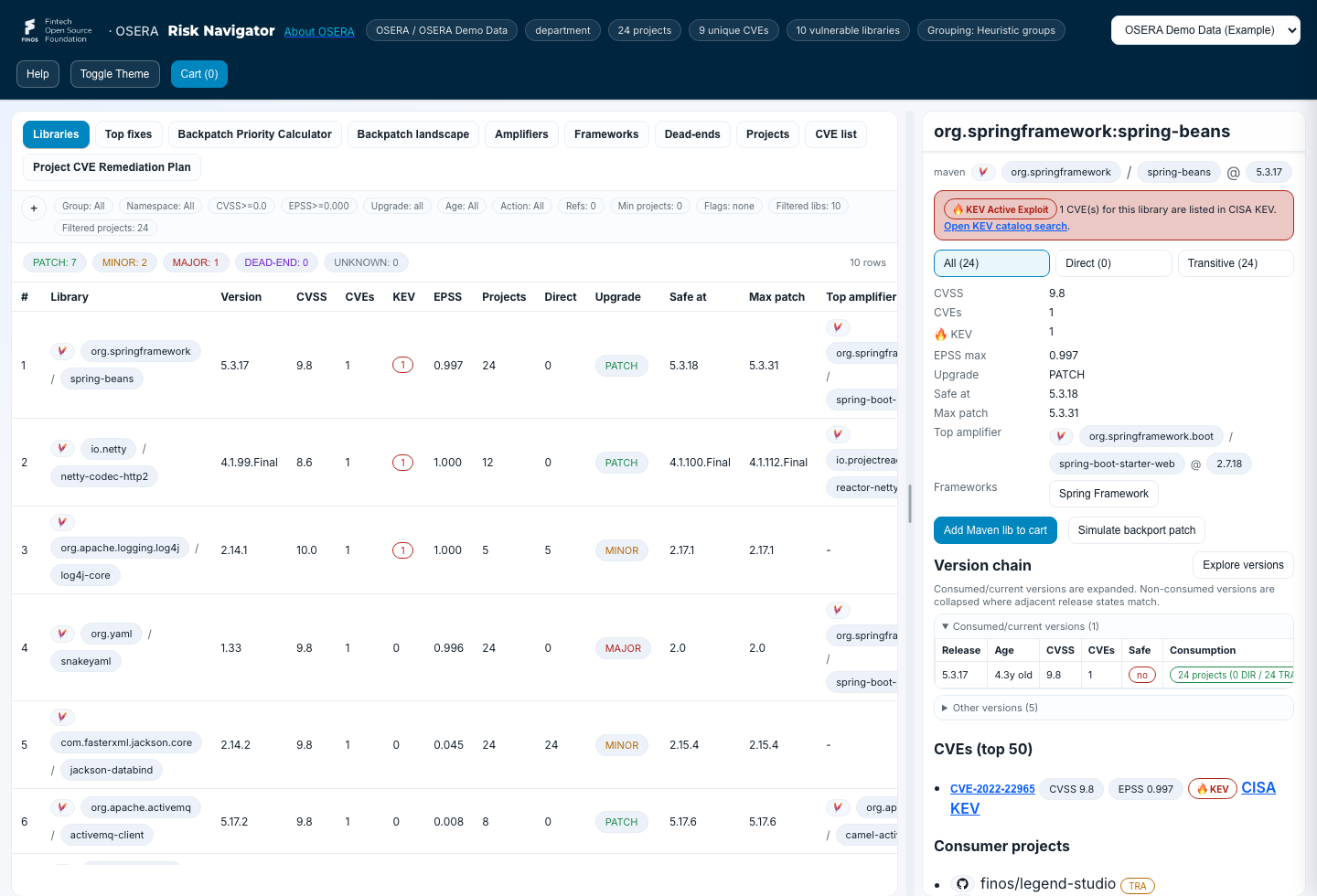
Risk Navigator
Where shared prioritisation happens. Cross-firm demand, severity and exposure are scored on one neutral basis to order the shared remediation backlog — so machine-speed CVE waves are triaged automatically, not in committee.
- Open Risk Navigator
- Explore the source on GitHub
- Ranks by CVSS, KEV, EPSS, footprint & overlap
- See it in action below
Regulated Consumption at Scale
The next frontier: consuming fixes in time across a regulated estate — and proving it. Regulatory compliance evidencing and shared consumption tools and recipes, alongside FINOS CALM.
- Consumption evidence, mapped to DORA, NIS2 & CRA
- Shared tools & recipes for rollout at scale
- Working group proposed for ratification next
- Register your interest
How to participate
Working-group meetings and mailing lists are open to FINOS members only — but no OSERA membership is required. Not yet a member? Become a FINOS member.
- Subscribe to the OSERA general mailing list — the front door for all alliance announcements.
- Join the OSERA general meetings — the schedule is on the general list calendar.
- Then pick your workstream: the Remediation Standards list for WS1, GitHub for WS2, or register interest in WS3.
An initial draft of proposed patching standards is available at standards.osera.finos.org